Arrange a Drinks Tray for Two People Without Crowding the Glasses
Carrying two tall glasses, a small syrup bottle, and a milk jug on a single tray requires deliberate placement decisions before you lift anything. On a standard 35 cm round or rectangular tray, the difference between a stable carry and a tipped glass often comes down to where the heaviest items sit and how much clearance exists between them. This guide works through the spacing logic, weight distribution, and a practical arrangement that keeps everything upright during a short indoor carry.
Read the note ↓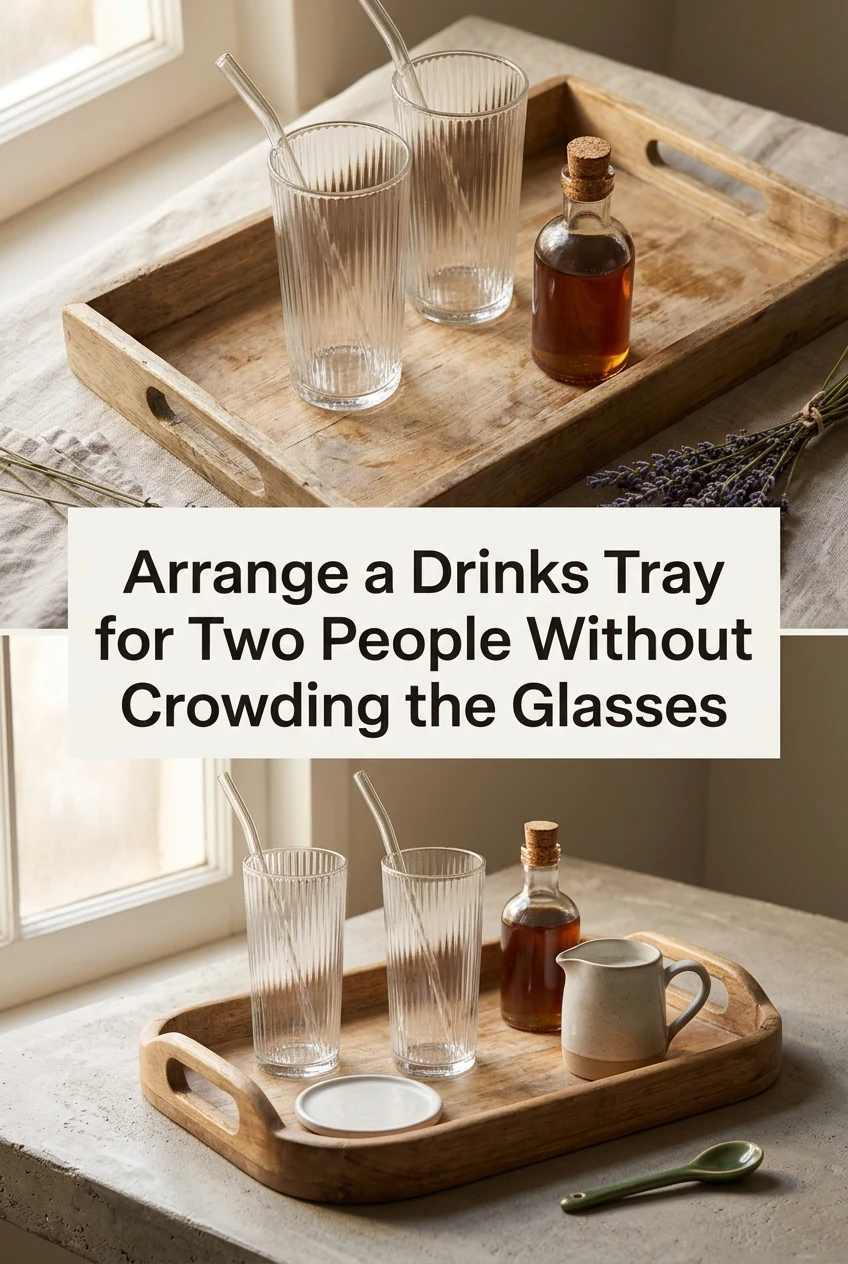
AI-generated editorial concept created for this article. The image is not a technical diagram or a tested result.
Understand the Weight Distribution Rule for Trays
Heavier items belong toward the center of the tray, directly above your carrying hand or hands, rather than near the edges. A full 350 ml tall glass weighs roughly 400 to 450 grams including ice and liquid. Two of them placed symmetrically on either side of the tray center keep the load balanced. The syrup bottle and milk jug, which are lighter, fill the remaining space. Placing a heavy glass near one edge creates a lever effect that makes the tray tilt when you shift your grip.
Map Out the Placement Before Loading the Tray
On a 35 cm rectangular tray, place the two tall glasses in the back half, spaced roughly 12 cm apart from center to center. This leaves the front half of the tray for the syrup bottle and milk jug, which are shorter and less likely to tip. The front position also makes them easier for the person receiving the tray to reach without leaning over the glasses. Visualizing the arrangement before placing anything prevents the common mistake of loading items and then realizing there is no room for the last piece.
Use a Non-Slip Tray Liner to Reduce Sliding
A thin rubber or silicone tray liner grips the bases of glasses and small bottles so they do not slide when you accelerate or change direction. Without a liner, tall glasses on a smooth tray surface shift with even small movements. Liners are available cut to standard tray sizes or can be trimmed from a larger sheet. Place the liner flat before loading any items. A damp cloth laid flat under the items is not a reliable substitute, as it can bunch and create an uneven surface.
Account for Handle and Spout Clearance on the Jug
A small milk jug with a handle or spout extends beyond its base footprint. Position the jug so its handle or spout points inward toward the center of the tray rather than outward over the rim. This keeps the protruding part within the tray boundary and reduces the chance of it catching on a doorframe or another surface during carrying. For example, if a jug has a 7 cm base and a spout that extends 4 cm beyond it, pointing the spout inward utilizes the open space near the tray center and keeps the spout from overhanging the edge without requiring the base to sit excessively far inward.
Carry the Tray With Two Hands for Short Indoor Distances
For a 35 cm tray loaded with two glasses and two smaller items, carrying with both hands flat under the tray provides more stability than a single-hand carry. Keep your elbows slightly bent rather than fully extended, which gives you room to absorb small movements without transferring them to the tray surface. Walk at a steady pace and avoid stopping abruptly. Set the tray down on a flat, stable surface before distributing the drinks rather than handing glasses directly from a held tray.
A little more
to know.
What is the maximum number of items that fit safely on a 35 cm tray?
This depends on item size, but four standard items, two tall glasses and two small vessels, is a practical limit for a 35 cm tray. Adding a fifth item typically forces at least one piece to the edge, reducing stability during carrying.
Should straws or spoons be placed on the tray or inside the glasses before carrying?
Place straws and spoons inside the glasses before loading the tray. Loose items on the tray surface slide freely and can fall between glasses or shift the balance. Keeping them inside the glass also means they are delivered with the drink automatically.
Original editorial guidance and recipe formulations, not independently kitchen-tested. Times are estimates and depend on equipment and product directions. Cooked bases need additional cooling and refrigeration before cold serving. Images are AI-generated illustrations; appearance and yield may vary. Check actual ingredient labels, allergens, and any certification you require. We do not certify products. Read our approach.
Save to Pinterest ↗ANOTHER IDEA FOR THE COUNTER