Adjust Grind Size for Dark Versus Light Roasts in Pour-Over
Dialing in manual pour-over drip coffee requires accounting for how roasting alters coffee bean cell structure. Light-roast beans retain high internal density and cellular moisture, fracturing into relatively uniform fragments with minimal dust. Conversely, dark-roast beans endure extended heat exposure, which degrades cellulose walls and creates a brittle, porous matrix. Grinding dark roasts produces an abundance of microscopic fragments known as fines, which migrate to the bottom of paper filters and stall water flow. Adjusting burr gap between roast profiles stabilizes drainage times and prevents bitter, astringent cups in manual drippers.
Read the note ↓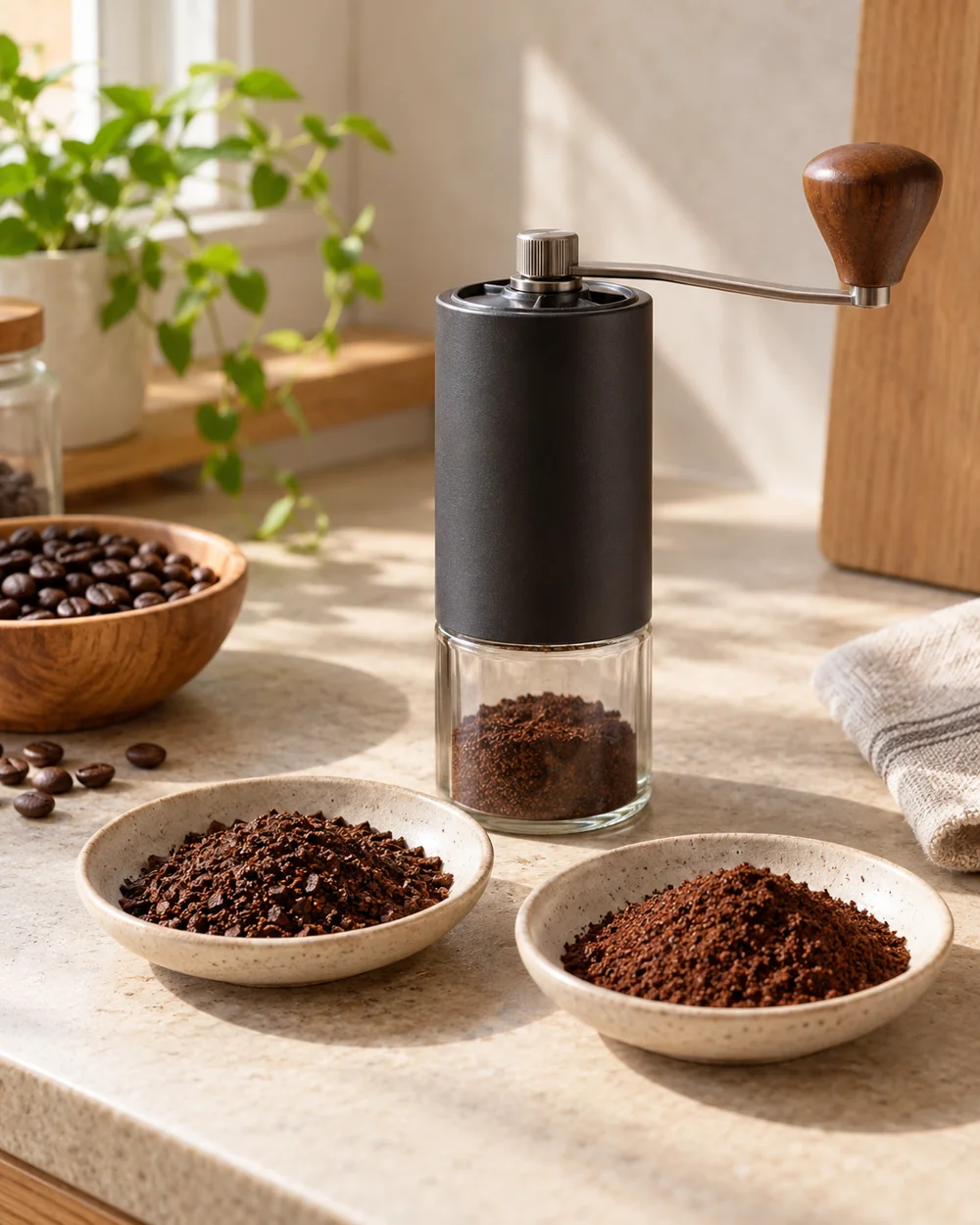
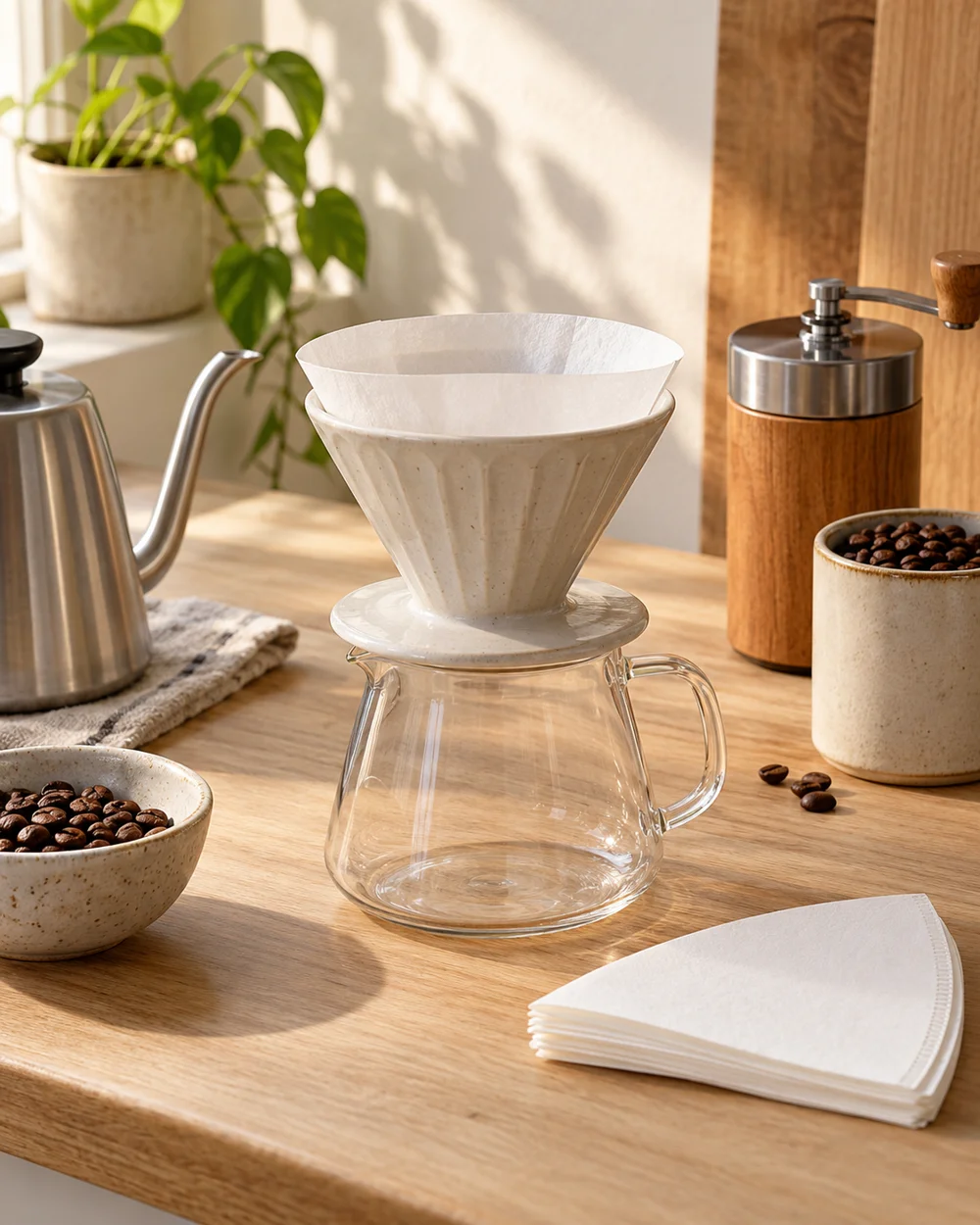
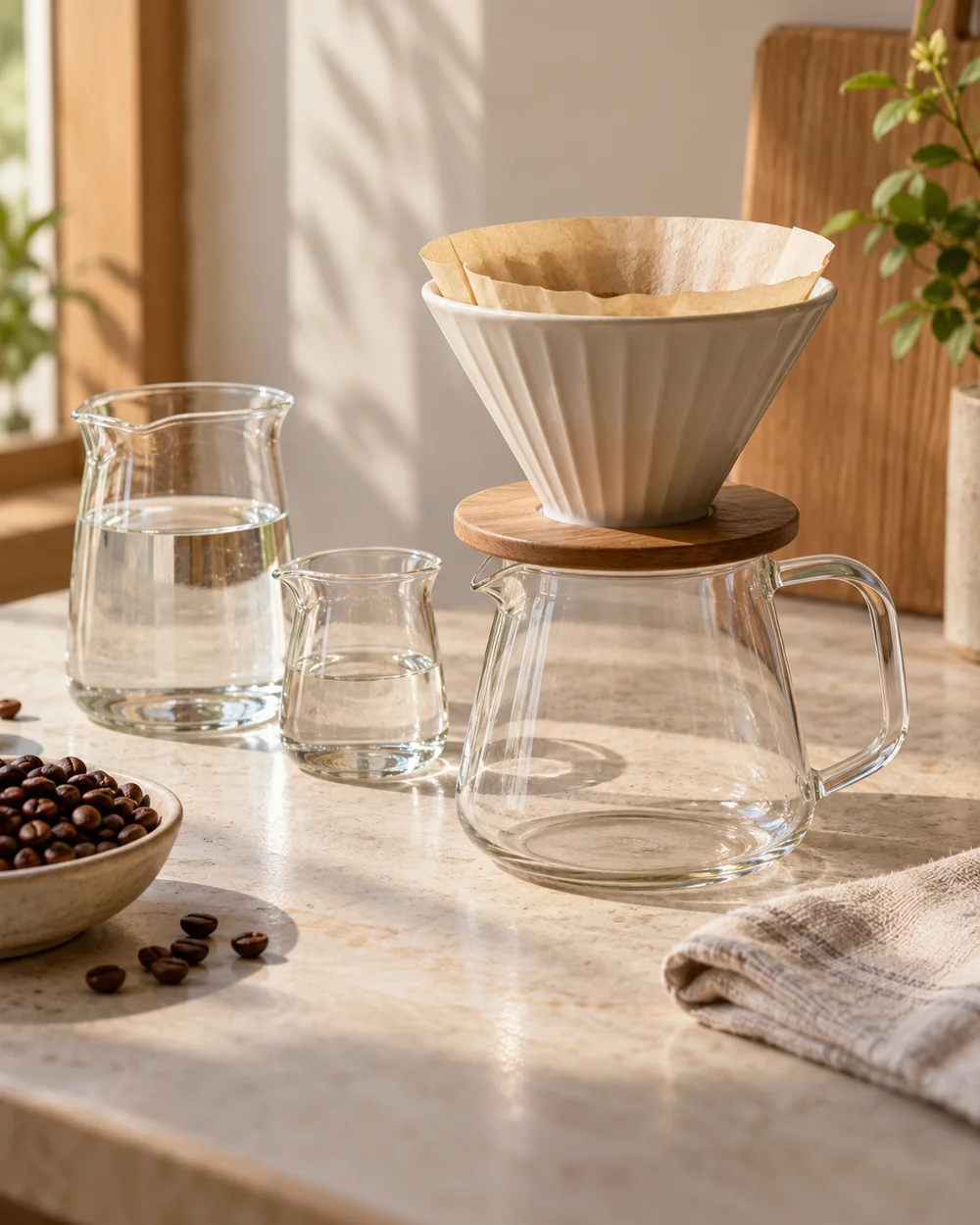
Representative category illustration reused from our editorial library; it does not depict this specific project or a tested result.
Structural Differences Across Roast Depths
Coffee roasting expands bean volume while driving off water and breaking down organic structural polymers. Light roasts retain tight, resilient cellular structures that resist shattering under the shearing force of grinder burrs. Dark roasts spend significantly more time in the roaster, losing structural mass and developing fragile, highly porous cell walls. When crushed between steel burrs, dark beans shatter readily, generating a disproportionate quantity of microscopic fines. These fine particles easily wash down through the brew bed, lodging into the pores of paper filter cones and restricting drainage.
Identifying Flow Stalls and Extraction Problems
A brew stall occurs when standing water pools above the coffee bed long after pouring finishes. If a light roast drains in three minutes at a given grind setting, applying that identical burr setting to a dark roast frequently extends drawdown past four or five minutes. Migrating fines compact against the bottom of the filter, forming an impermeable layer of silt. The resulting prolonged contact pulls harsh, acrid compounds and astringent polyphenols into the cup, obscuring sweetness and muting origin characteristics.
Worked Dialing Parameters for Manual Drippers
Consider a standard pour-over recipe using 15 grams of ground coffee to 250 grams of water in a conical paper brewer. If a dense light roast brews evenly in three minutes at a medium setting, a dark roast requires adjusting the grinder coarser by two to three clicks on a stepped hand grinder. This adjustment widens burr gap by approximately 60 to 90 microns, shifting the median particle size coarser. The slightly larger primary grind size opens gaps between grounds, allowing water to bypass accumulated fines and restoring total drawdown to roughly three minutes.
Agitation and Temperature Modifications
Coarsening the grind setting should be paired with controlled kettle pouring. Pouring from high above the dripper creates turbulent churning that drives fines deep into the paper fibers, accelerating clogging. Keep the kettle spout low, roughly 3 to 5 centimeters above the brew bed, pouring in slow, gentle concentric spirals. In addition, lower brewing water temperature from 93 to 96 degrees Celsius down to 88 to 90 degrees Celsius. Dark roasts are more soluble and extract readily; lower water temperatures prevent over-extracting bitter chlorogenic acid degradation products.
Evaluating the Spent Coffee Bed
Inspecting the drained coffee bed provides visual confirmation of proper particle sizing. A properly extracted light roast leaves a flat bed resembling wet beach sand with a light coating of silt. A balanced dark-roast bed should display clear, distinct granular facets across its surface rather than a smooth, clay-like mud slick. If standing water remains trapped over a dense layer of silt after three and a half minutes, widen the burr setting further on your next brew cycle.
A little more
to know.
Does bean age alter how dark roasts fracture in a grinder?
Yes. As roasted beans age past four weeks, cellular moisture continues to dissipate and bean structures become increasingly brittle. Older dark roasts produce more microscopic fines during grinding than freshly rested beans, often requiring an additional burr click coarser to maintain target flow rates.
Can I resolve dripper stalling simply by pouring water faster?
Pouring faster increases hydraulic head pressure briefly, but the added agitation drives fines straight into the filter pores, worsening the obstruction. Adjusting particle size coarser before brewing is the correct mechanical method to preserve steady flow through the filter paper.
Original editorial guidance and recipe formulations, not independently kitchen-tested. Times are estimates and depend on equipment and product directions. Cooked bases need additional cooling and refrigeration before cold serving. Images are AI-generated illustrations; appearance and yield may vary. Check actual ingredient labels, allergens, and any certification you require. We do not certify products. Read our approach.
Save to Pinterest ↗ANOTHER IDEA FOR THE COUNTER